
How to Get Paid for Work Your Client Can Already Do
It is becoming easier by the day to produce things that, only a few years ago, would have justified hiring a specialist or a consulting firm. The hard part now is explaining why we need to hire one at all.
I currently work at a big tech company, and I find it increasingly difficult to find partners and providers of specialist expertise (aka “consulting firms”) selling something we actually need to buy. Many arrive with a strategic design proposition: interviews, analysis, opportunities, concepts. Some add development as well. The problem is that we can do both in-house, with considerable skill and one advantage that is hard to outsource: we know the business inside out.
Then we switch seats and try to sell our own solutions. From the other side of the table, the same question comes back to us: why should I pay for your solution if I can build something tailored to my needs with Claude or ChatGPT?
It is an uncomfortable position. I am asking my suppliers for the same explanation that my clients are beginning to ask of me.
Let us accept the promise made by AI vendors for a moment: producing software, analysis, documents, and research is becoming cheaper and cheaper. We do not have to believe that everything will be free, perfect, and autonomous. It is enough that a growing share of the work can no longer justify its current price. So what will we sell as digital-service providers? What will the Accentures of the world have to offer? And what will the new boutiques—the next Designits born into this abundance—sell?
The Method Can Be Learned
During the rise of digital services, firms such as Fjord, Designit, and The Cocktail helped introduce a different way of working: observing users, questioning the brief, prototyping before building, bringing design and business together. For many companies, this was a capability they did not yet have. Many did not even understand it, but fortunately they had astute leaders willing to stake their reputations on bets that, at the time, seemed fairly arcane.
I think I know that world. We delivered projects of enormous value to our clients, and it is only fair to admit that we also had spectacular failures. Little by little, we learned to package these mechanisms for creating value into recognizable processes: phases, workshops, maps, post-its. The method was just as useful for doing the work as it was for making the work visible. Sometimes it was difficult to tell those two functions apart.
But it was—and still is—expensive, and clients realized that the whole setup rested on relatively “cheap” specialists. So they brought designers, researchers, and product teams in-house. They learned the vocabulary, the tools, and much of the craft. A capability that can be taught and absorbed eventually becomes difficult to sell as a secret.
AI has accelerated this erosion. Understanding and isolating a problem, preparing a work plan, synthesizing interviews, or building a prototype takes less and less effort. Going out to discover something we do not know—or even determining which parts of what we do not know are worth discovering—still has value. But producing yet another presentation containing what the organization already knows is starting to feel uncomfortable: we want the outcome, not the map for reaching it. I suspect the next generation of boutiques will have a problem if all they offer is “AI” added to the front of the same old catalog. The client has access to the tools too, and can now ask how much they are paying for the work and how much for the theater around it.
The Geometry of Billable Hours
Traditional consulting is shaped like a pyramid because its economics are shaped like one. A broad base of young professionals researches, analyzes, and produces; several layers review and coordinate; a handful of partners sell the engagement and maintain the client relationship. The margin depends on how those hours are combined and billed.
AI touches precisely the work that allows the base to widen. In an experiment involving 758 BCG consultants, those using GPT-4 completed certain tasks 25.1% faster and to a higher standard. On other tasks, outside the model’s effective frontier, using it made the results worse.
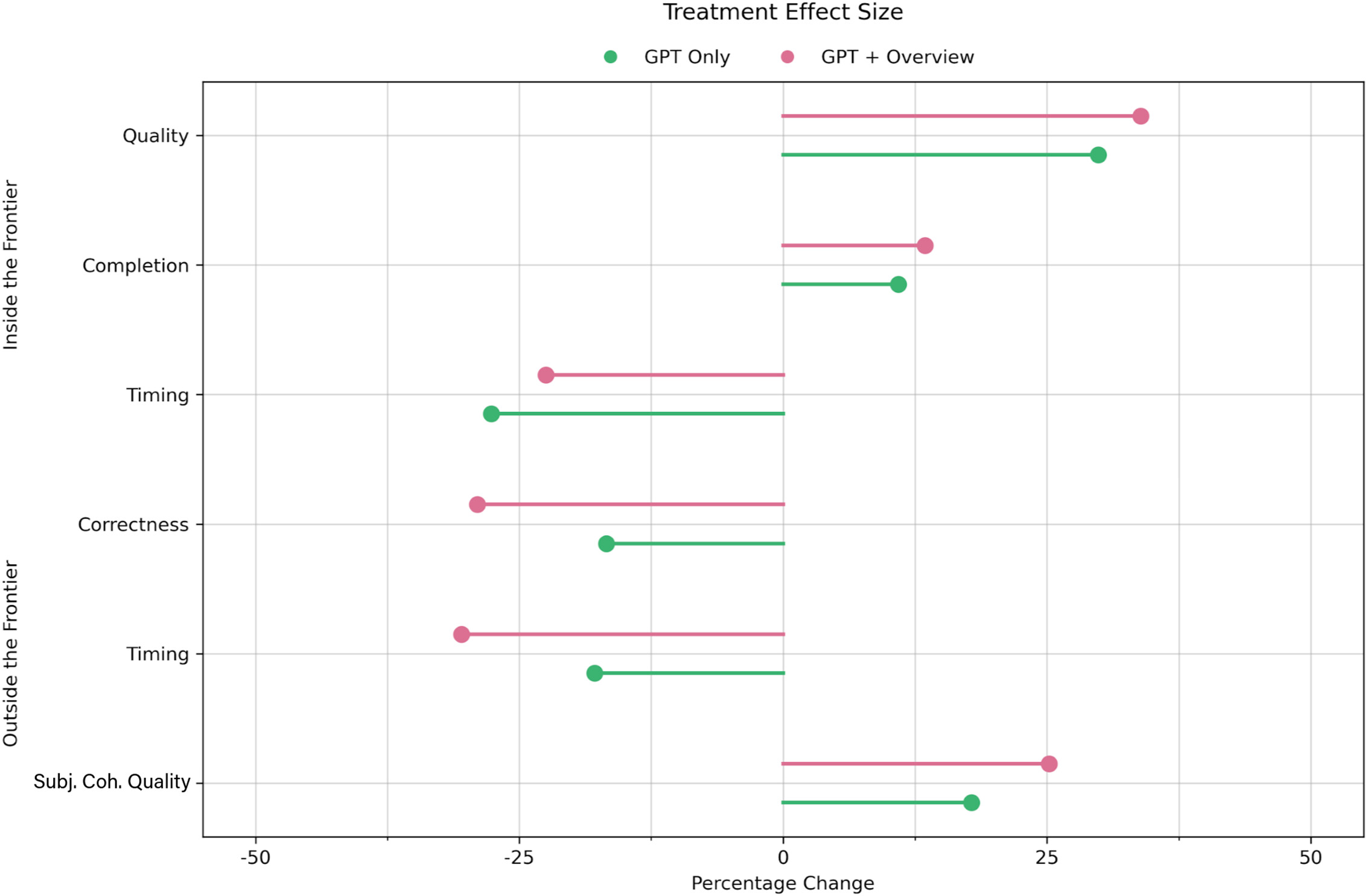
Source: Navigating the Jagged Technological Frontier: Field Experimental Evidence of the Effects of Artificial Intelligence on Knowledge Worker Productivity and Quality (Organization Science 37-2)
Producing more with the same team complicates the conversation about price. If an engagement requires far fewer hours and the client knows it, maintaining the fee means explaining what else they are buying. Increasing the supplier’s productivity and increasing the buyer’s value are two different things.
In Harvard Business Review, Duncan, Anderson, and Saviano propose the image of the obelisk: a narrower organization, with fewer layers and three main functions:
- AI facilitators: people who build and refine AI and data workflows.
- Engagement architects: professionals who frame the problem, interpret the results, and orchestrate delivery.
- Client leaders: people responsible for trust, decisions with the client, and the long-term relationship.
Two of the authors run an AI-native consultancy cited as an example in the article. They are proposing a model whose long-term evidence has yet to be built.
The obelisk allows us to imagine greater delivery capacity without equivalent headcount growth. But slimming down the structure means reconstructing the functions those layers performed: checking sources, reviewing difficult cases, and understanding why each decision is made. A manager who makes decisions faster may end up multiplying mistakes with extraordinary efficiency.
The pyramid was also a school, albeit often a precarious one. As junior professionals, we learned by producing, receiving corrections, and seeing what happened when a recommendation came into contact with reality.
An obelisk made up entirely of veterans and agents may be profitable for as long as the veterans’ experience lasts. After that, it will have to explain where the next generation comes from. And all of us will have to keep learning and unlearning: judgment also ages, reproduces biases, and makes mistakes. Invoking it as the last impregnable human faculty strikes me as another way of postponing the problem.
These firms will need to keep renewing their expertise: bringing young people into real engagements, making decisions visible, and turning failures into better systems. Being small will do them little good if every engagement starts from scratch or if only the partner who sold it knows how to solve it.
The Work That Disappears from the Invoice
The GenAI Divide, a report by MIT NANDA, contains an interesting clue. Among its best-performing cases, it describes savings on outsourced services and a 30% reduction in spending on creative and content agencies, without substantial cuts to internal headcount associated with those savings.
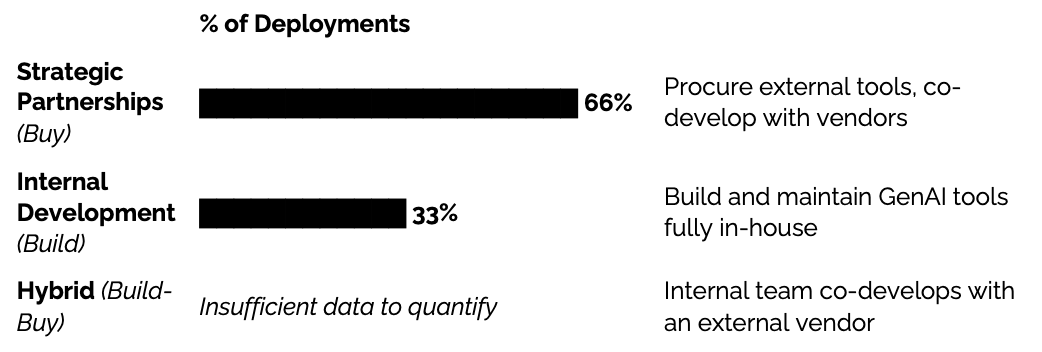
Source: The GenAI Divide, MIT NANDA
It should be read for what it is: a preliminary 2025 report based on more than 300 public initiatives, interviews with 52 organizations, and surveys of 153 senior executives. That 30% applies to the highlighted cases; it is not an estimate for the industry as a whole. But the direction feels familiar: a team can adopt AI, get more out of its own professionals’ time, and stop buying some of that work from outside. Automation may show up in the supplier’s invoice before it shows up in the client’s headcount.
The same report finds higher deployment rates in projects involving external partners than in internally developed projects, although it warns that the comparison does not establish causation. Both observations can be true at once: a company may dispense with one provider of deliverables while needing another to change how an operation works.
This matches my experience. Knowing the business allows us to do many things ourselves. It also makes us less patient with providers who need us to explain everything, only to return weeks or months later with a tidy version of what we already told them. A useful partner has to bring something that justifies that effort: experience with problems we have not yet encountered, a proven capability that would take us too long to build, or access to resources—contacts, infrastructure, and so on—that we do not have.
SaaS Discovers That It Sells Work, Too
The objection to our own solutions deserves the same scrutiny. Being able to build an application changes the buying calculus. If a SaaS product amounts to a few screens, some rules, and a workflow, an in-house alternative may be good enough. Today, even a freelancer can build a solution tailored to their own needs and way of working. Many already do.
And yet, building a tool is not the same as taking responsibility for it for years. There are integrations, changes to the business, incidents, and bugs. Anyone who has built software understands the effort required to keep a solution current. In the digital world, rust and cobwebs appear within days. And then there is everything else that does not get built while you are working on it.
Buying software will continue to make sense whenever that entire package is better than the in-house alternative. What is weakening is the right to charge a subscription simply because we can build something the client cannot code.
In Services: The New Software, Sequoia’s Julien Bek describes an interesting shift: selling completed work allows a company to capture some of the value of the service, far beyond the cost of the tool itself. Each improvement in the model can then reduce operating costs and increase the supplier’s margin. The natural entry point for this approach is work that the client already outsources to service providers and contingent workers, where there is a recognized need and an existing budget line to reduce.
Sequoia obviously has a vested interest in seeing companies like these emerge. It is an investment thesis, still to be demonstrated at scale, but it helps us imagine two businesses that once seemed separate moving closer together: a consultancy turning its experience into reusable systems, and a technology company seeking to take ownership of its clients’ workflows.
There are already concrete signals. Crosby provides legal services for commercial contracts by combining agents and lawyers, advertises fixed prices per document, and says it carries professional liability insurance. Sierra describes a pricing model tied to agreed outcomes, such as resolving a support inquiry, and allows for blended models when that unit does not fit. In banking, a growing number of mortgage comparison and advisory firms, having exhausted their room for growth in B2C, are pitching themselves to banks as mortgage-processing partners that can accelerate internal workflows, including sales.
Little by little, the question for providers is becoming how much work and responsibility the client can actually delegate.
The Next Designits
There is nothing particularly new about outsourcing a problem and paying someone else to deal with it. The difference lies in the economics of the operation. When a service depends primarily on human hours, serving more clients usually requires more people. An AI-native boutique would invest in turning part of its experience into systems capable of doing the work: each new engagement would make use of an existing capability and help improve it. AI can expand the portion of the service delivered this way, including tasks that once required professional attention case by case. Its advantage would depend on how much better it gets at delivery with each client, without having to rebuild an equivalent team for the next one.
These new boutiques will probably attack problems far narrower than “transforming your business.” They are more likely to focus on things such as onboarding distributors in a particular industry, handling returns in a specific retail category, or preparing industrial bids. In other words, processes concrete and repetitive enough to accumulate experience; awkward enough that someone will pay to forget about them; and entrenched enough that internal staff and teams put up considerable resistance to changing them.
Take a hypothetical example: a company takes too long to onboard new distributors. There are forms, contracts, incomplete documentation, several applications, and approvals chased by email. Today, we might sell it a research project, a process redesign, or… a portal.
An AI-driven consulting firm would begin by analyzing real cases. It would discover where they get stuck, separate genuinely essential checks from mere “custom,” and build a solution on top of the systems already in place. It would automate what can be repeated, route exceptions to people with the authority to resolve them, and measure what happens with the next distributor. Then it would stay. When a requirement changed, when an unusual case appeared, or when the process became stuck again. The client would buy the launch and continued operation of a capability.
The team could be small, but it would need depth. Someone who understands the operation, someone capable of building it, and someone able to get the different areas involved to agree on how to work. Sometimes those would be three different people; sometimes the capabilities would overlap. The organization chart would matter less than their autonomy to carry a decision through to its consequences. And they would need someone inside the client organization with enough authority to transform the process.
One of their main assets would be everything they learn each time they operate. Difficult cases would become tests; decisions, explicit rules; corrections, verified improvements. Some of that knowledge would belong to the client. Some could become reusable tools and patterns, while respecting confidentiality and data rights. The next project would begin with something more substantial than a presentation template.
Their other major asset would be speed and adaptability: the ability to test new solutions and approaches without submitting every adjustment to the full weight of internal bureaucracy. The client could stop managing every test, failure, and pivot while retaining the ability to review what changed and what the result was.
That would justify hiring someone who knows less about our company than our own team does: besides bringing accumulated experience with a problem that is new or difficult for us, they could turn that experience into a solution that works and improves over time.
These partners would also need to rethink their cost structure. They would have to invest before they could bill: building components, preparing evaluations, maintaining systems. Unity Advisory launched in 2025 with an initial capital commitment of up to $300 million from Warburg Pincus, focused on services for CFOs and with AI at the heart of its proposition. A boutique does not need a check that large, but the example reminds us that capital, distribution, and the ability to sustain the service will matter too.
It seems more plausible to me that these new firms will combine a retainer for operating and improving the service with a variable component when outcomes can be attributed. Promising to charge only for impact sounds wonderful until you discover that you depend on the client’s data, decisions, and sales budget. The numbers point in that direction: according to SPI Research, outcome-based pricing still accounts for less than 8% of AI consulting contracts, and most engagements are structured as time and materials with a budget cap or a fixed price per phase, precisely because the outcome depends too heavily on what the client contributes.
But there is another, less visible opportunity: taking on work that nobody used to do because it was not worth paying for. Reviewing the long tail of minor issues, adapting a service for underserved segments, testing improvements that never received a budget. Lower costs can expand what a company considers possible. When people say, for example, that AI has fixed bugs in software used at scale, it has not suddenly made the impossible possible. It has tackled problems that were previously too expensive to hunt for. Chrome incorporated 1,072 security fixes across two releases in June 2026, more than in the previous twenty-three releases combined, and one of those bugs had been sitting there for thirteen years. Nobody had decided it did not matter; there had simply never been enough hours to find it.
So Where Does That Leave Design?
Those of us who come from design should take this seriously. A boutique that commits to an operation needs to understand the people who use it, how they make decisions, and what happens when something goes wrong. There is plenty of design work there. In the distributor example, someone will need to decide what information to ask for, when to ask for it, what the system can resolve, and how to explain a rejection. They will also need to notice when a faster process merely shifts work onto the client or excludes difficult cases.
At the same time, not every valuable intervention begins with an immediate return. Exploring an opportunity or ruling out a bad bet can justify an engagement. Design can shape what an organization should do and how to help it do that well. AI makes it possible to bring that decision closer to a real-world test at much lower cost. A small firm could research, build, observe actual use, and correct course without passing the problem from one department to another.
The next Fjords may be recognized by the kind of problem they take responsibility for. Design practice will be embedded in how they solve it, even when it no longer appears in the headline of the sales pitch.
But we should not fool ourselves. The examples we have seen in financial and legal services begin with a tightly defined scope: reviewing an invoice, filing a tax return, processing a contract. That makes it easier to define what is delivered and how it is priced. Yet a reviewed invoice is a unit of work; a saving is an outcome; and taking responsibility for an error requires agreement on what liability the provider assumes and how it will put things right. Counting units does not solve all three. We already know how to count screens, reports, and post-its.
So what is design’s unit of account? As long as the answer remains a value proposition, a concept, or an experience, we are in trouble. The uncomfortable alternative is to bind ourselves to a unit that is not traditionally ours—conversion, support costs, onboarding time, error rates, complaints avoided—and accept being measured against it. This is precisely what design consulting has avoided for twenty years, with the reasonable argument that design’s value is diffuse and takes time to emerge. The argument remains reasonable. What is no longer clear is whether anyone will keep paying on that basis.
Epilogue: The Price of Taking Ownership
I return to the discomfort at the beginning. As a buyer, I can pay for something I know how to do if someone else does it better or takes on complexity I would rather delegate. As a seller, I will have to earn that same right.
The question every provider should be able to answer is fairly concrete: what can the client stop dealing with once they hire us? “We provide hands / hours / people” is no longer an acceptable answer. Today, execution capacity tends toward infinity.
Yet even with all that execution capacity, there will still be problems that nobody has understood properly, decisions that nobody wants to make, and operations that become stuck between departments. Small teams, both internal and external, now have the capacity to step into those spaces and change something for real.